
Quick Answer
The foods most people keep down in early pregnancy tend to be cold, bland, salty, and eaten in small amounts before you ever feel hungry. NHS and ACOG both point to small, frequent, low-fat meals — but the exact thing that stays put is weirdly personal. The full categorized list of 20 ideas (and which combos to pair) is in section two below.
So Why Does Everything Suddenly Make You Gag?
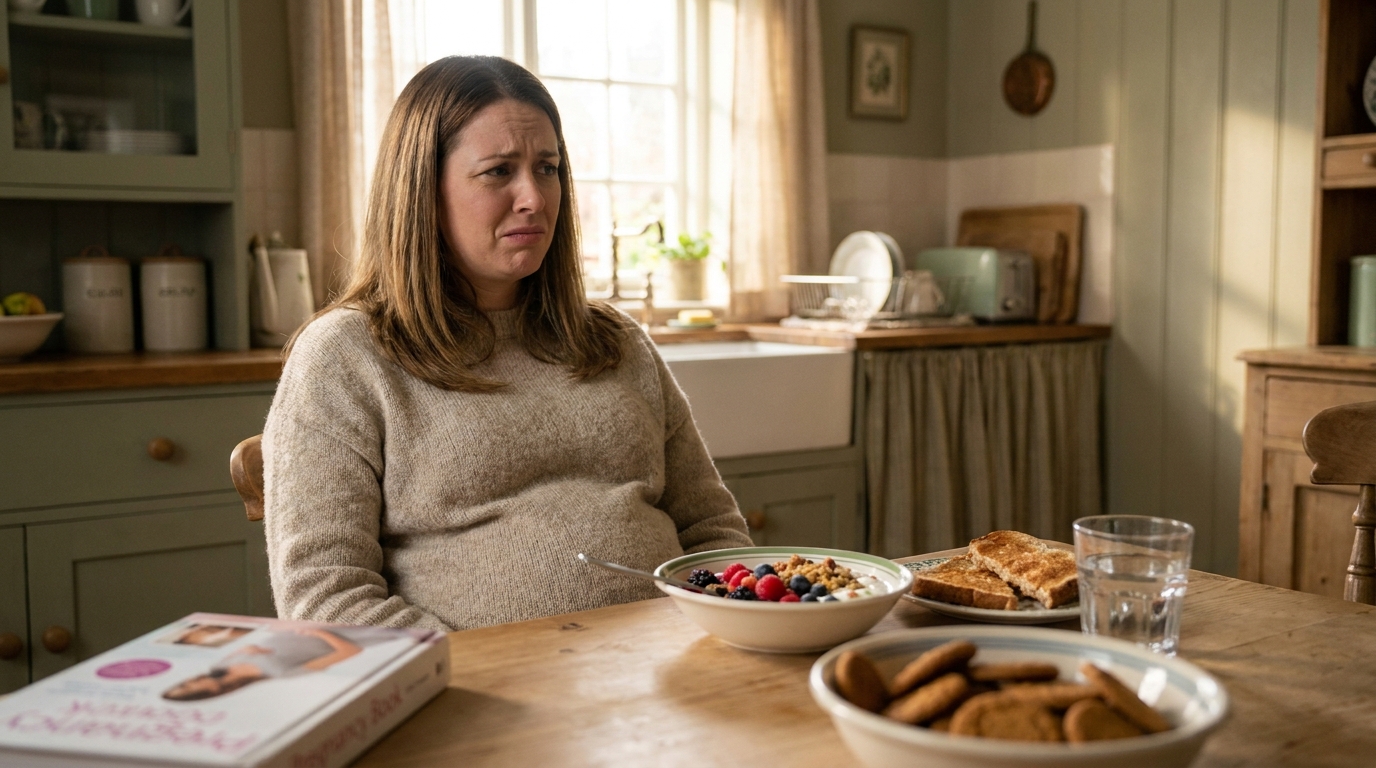
Okay, can we talk about this for a second? In the first trimester your sense of smell turns into a superpower you absolutely did not ask for. The coffee you loved last month now smells like a crime scene. That's not in your head — heightened smell is one of the most documented features of nausea and vomiting of pregnancy, and it's exactly why hot food (which sends steam and odor straight up your nose) is so much harder than cold food.
There's a blood sugar piece too, and this one actually explains the "morning" part. When your stomach is empty — like first thing after sleeping all night — your blood sugar dips, and that dip can crank the nausea up. According to NHS guidance, the move is small, frequent meals of plain foods that are high in carbohydrate and low in fat — bread, rice, crackers, pasta. ACOG adds the classic trick: keep dry toast or crackers by your bed and eat a few before you even sit up, so you're not moving around on a totally empty stomach.
So the winning formula isn't really about "healthy." It's about: cold (less smell), bland (less to react to), small (doesn't overwhelm your stomach), frequent (no blood sugar crashes), and ideally a little protein to keep that blood sugar steady. Hold that template in your head — every idea below is just a remix of it.
20 Nausea-Friendly Meals and Snacks (The Full Keep-It-Down List)
I'm not gonna lie, half of these barely qualify as "cooking." That's the point. This is the survival list, sorted by category so you can scan for whatever your stomach is voting for today. None of this is a prescription — everyone's nausea has its own rules — but these all line up with the cold/bland/small/frequent template the guidelines describe.
Salty and dry (the empty-stomach savers)
| Idea | Why it works | Best for | Prep effort |
|---|---|---|---|
| Plain saltine or water crackers | Dry + salty absorbs stomach acid, almost no smell | Before getting out of bed | Zero |
| Pretzels | Salt + carb, no fat, travels in a bag | Mid-morning crash | Zero |
| Dry toast or a plain bagel | Carb-heavy, low fat, eat it cool not hot | First thing AM | Low |
| Salted rice cakes | Bland, crunchy, zero odor | Snack anytime | Zero |
| Plain bread sticks (grissini) | Same logic as crackers, less crumbly | Purse/desk stash | Zero |
Cold and refreshing (when heat makes it worse)
| Idea | Why it works | Best for | Prep effort |
|---|---|---|---|
| Cold watermelon or melon chunks | Hydrating, cold, mild, easy sugar | Afternoon slump | Low |
| Frozen grapes | Cold + slow to eat, soothing on a sore throat from acid | Evening | Zero |
| Chilled cucumber slices with a little salt | Watery, cold, almost no smell | Any time | Low |
| A cold fruit smoothie (sip slowly) | Calories without chewing when nothing sounds good | When solids fail | Low |
| Cold pasta salad (plain, light dressing) | NHS-style high-carb low-fat, no hot-food steam | Lunch | Medium |
Carb-plus-protein combos (steady blood sugar)
| Idea | Why it works | Best for | Prep effort |
|---|---|---|---|
| Crackers + a smear of cottage cheese | Carb anchors the protein so blood sugar doesn't crash | Mid-morning | Low |
| Plain bagel + a slice of mild cheese | Filling, bland, holds you between snacks | Lunch | Low |
| Toast + a thin layer of nut butter | Protein + carb, eat it cool | AM if fat is tolerated | Low |
| Cold plain Greek yogurt with a few crackers | Cold + protein, gentle on smell | Snack | Zero |
| Hard-boiled egg + a few crackers (if eggs sound okay) | Protein steadies blood sugar; cold reduces smell | Lunch | Low |
Warm but gentle (for the days you can handle it)
| Idea | Why it works | Best for | Prep effort |
|---|---|---|---|
| Plain white rice or congee | Soft, bland, easy to digest | Dinner | Medium |
| Buttered plain pasta | NHS-friendly carb base, keep it simple | Dinner | Medium |
| Clear broth or plain soup, lukewarm | Fluids + sodium without strong odor | When fluids are hard | Low |
| Plain baked or mashed potato | Comforting carb, low fat if you go easy | Dinner | Medium |
| Oatmeal made plain (let it cool a bit) | Slow carb keeps blood sugar steady longer | AM | Low |
If you want these turned into actual trimester-safe recipes built around whatever's in your fridge, that's basically the whole reason Jake built Mombite — you tell it what you've got and it pulls bland, first-trimester-friendly options. No pressure, just an option for the days standing at the counter feels like too much.
Drinks That Help the Nausea Settle

Fluids get tricky because gulping can set off the gag reflex, and dehydration makes nausea worse — a frustrating loop. The NHS tip that helped me most: sip little and often instead of downing a glass. Cold water, ice chips, or watered-down juice tend to go down easier than anything warm.
On ginger — there's real evidence it can ease nausea, and the NHS lists ginger foods like ginger tea, ginger biscuits, or ginger ale as worth a try. One important nuance: the UK's Committee on Toxicity concluded that ginger eaten the normal culinary way (in foods and drinks) isn't a concern, but concentrated ginger supplements vary a lot in strength and have thinner safety data — so the standing advice is to check with your pharmacist before taking a ginger supplement. Food-form ginger and a supplement are not the same thing, and that distinction matters.
If you're losing fluids to vomiting, your stomach's salts and sugars get thrown off, which is its own kind of awful. This is exactly where you stop self-managing and loop in your OB or midwife — they can tell you whether you need a rehydration plan, and that's a conversation worth having early rather than white-knuckling it.
What to Do When You Can't Keep Anything Down
Here's the part I really want you to read, because there's a line between "miserable but normal" morning sickness and something called hyperemesis gravidarum that needs medical care. I'm not here to scare you — most nausea, even the brutal kind, isn't this. But knowing the red flags means you don't sit at home wondering.
According to NIH MedlinePlus and the NHS, call your OB, midwife, or pregnancy line if you have any of these:
| Red flag | What it can signal | Action |
|---|---|---|
| Can't keep any food or fluids down for ~12–24 hours | Dehydration risk | Call your OB / midwife / pregnancy line |
| Very dark urine, or you're peeing much less than usual | Dehydration | Call same day |
| Feeling very weak, dizzy, or faint when you stand | Dehydration / low blood pressure | Call same day |
| Losing weight (more than ~5% of your body weight is a flag) | Possible hyperemesis gravidarum | Call your OB |
| Vomiting blood, or vomiting 3–4+ times a day | Needs assessment | Call urgently |
| Severe abdominal pain or a high temperature | Needs assessment | Call urgently / seek urgent care |
Hyperemesis gravidarum is defined partly by losing more than 5% of your pre-pregnancy weight along with persistent vomiting and dehydration, per NIH MedlinePlus. It's treatable — but it usually needs your care team, not just more crackers. Please don't tough it out alone if you're hitting these signs. Your OB knows your full picture, and there are real options.
This overlaps a lot with general early-pregnancy survival, so if you want the wider picture of what week-by-week feels like, our first trimester survival guide walks through the symptoms and food angles together.
When Does This Actually End?

The question everyone whispers at 2am. The honest answer: it's individual, but the guidelines give a rough map. The NHS notes that morning sickness usually clears up by around weeks 16 to 20 — so for a lot of people the worst of it eases as the first trimester winds down and the second begins. Some get a faster reprieve, some carry it longer, and a small group deals with it much of the pregnancy.
As things ease, you don't have to leap straight back to elaborate meals. Reintroduce gently: keep the bland carbs, slowly fold in more protein and veg, and notice which smells you can suddenly tolerate again (it's a genuinely nice milestone). If you're around the week-10 mark and curious what's happening with the baby and your appetite as this shifts, our week 10 guide covers that transition. And cottage cheese keeps showing up on these lists for a reason — if you're wondering how it fits into pregnancy, we dug into cottage cheese in pregnancy separately.
Frequently Asked Questions
What foods are easiest to keep down with morning sickness?
For a lot of people it's the cold, bland, salty, dry stuff — crackers, pretzels, dry toast, cold melon, plain rice or pasta. Both ACOG and the NHS point to small, frequent, low-fat, high-carb foods. That said, nausea is weirdly personal — the thing that saves your friend might gross you out. The categorized list above is a starting menu, not a rulebook.
Why do cold foods help with pregnancy nausea?
Hot food gives off steam and stronger smells, and in the first trimester your sense of smell is dialed way up — that's a big nausea trigger. Cold foods release far less odor, so they sneak past the gag reflex more easily. The NHS specifically suggests trying cold meals instead of hot ones if cooking smells make you feel sick.
Is it okay to eat "junk" if it's the only thing that stays down?
Realistically, getting some calories and fluids in beats getting nothing in, and plenty of people survive early nausea on toast, crackers, and ginger ale. The goal during the worst weeks is keeping food and fluids down, not nailing perfect nutrition. As nausea eases you can rebuild variety. But if days are turning into a week of barely eating, that's a flag to loop in your OB or midwife rather than ride it out.
When does morning sickness usually ease up?
The NHS says it typically clears up by around weeks 16 to 20, so for many people it fades as the second trimester begins. It's a range, not a guarantee — some feel better sooner, some later. If yours is severe or dragging on, that's worth raising with your care team.
When is nausea serious enough to call my OB?
Call your OB, midwife, or pregnancy line if you can't keep any fluids down for roughly 12 to 24 hours, your urine is very dark or scarce, you feel very weak or dizzy, you're losing weight, you're vomiting blood, or you have severe belly pain or a fever. Per NIH MedlinePlus, losing more than 5% of your body weight with relentless vomiting can point to hyperemesis gravidarum, which is treatable but needs medical care. When in doubt, call — that's literally what the line is for.